



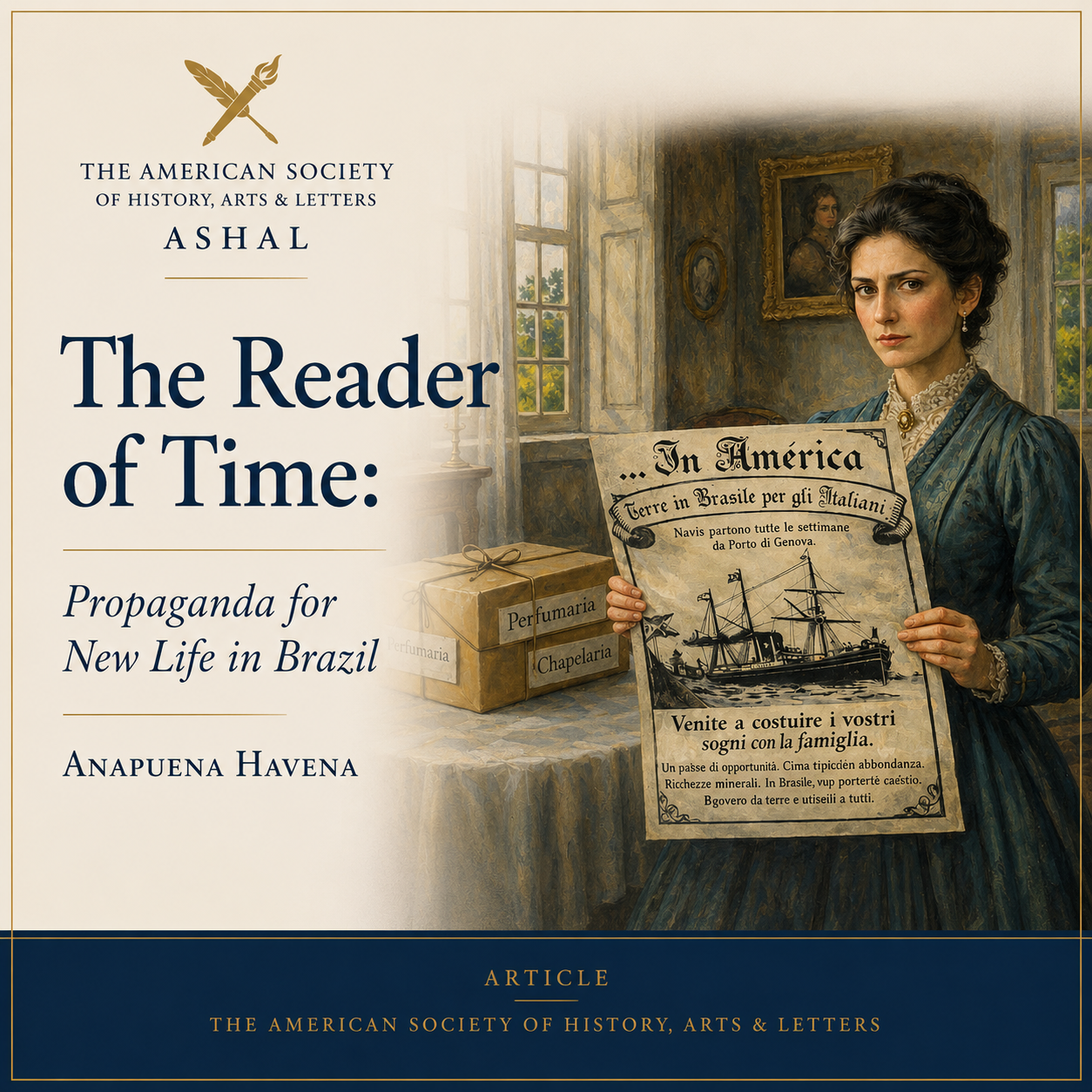
The Reader of Time: Propaganda for a New Life in Brazil
Anapuena Havena
It was a sunny September morning in 1890, and I set out early for Rua do Ouvidor. The day before, a note from the perfume shop had arrived, announcing a new fragrance from Paris. I lingered longer than expected, for as I passed the milliner’s shop—which stood before the perfume shop along my route—a silk hat displayed in the window caught my eye. And so I returned home with two packages in my hands.
As I approached the entrance gate of my residence, I noticed a piece of paper lying on the ground. It stirred my curiosity and, I confess, even made a good impression on me.
I picked it up. Curious, I went quickly into the house, dropping the packages on the small table in the sitting room. I sat down and examined the paper carefully.
“Marieta!” I called to the new maid.
“How may I be of service, ma’am?” the woman replied, her accent pronounced, as she appeared in the room.
“Would you be so kind as to translate these words? I can understand very little of them. I believe they are written in Italian,” I said, showing her the paper in my hands.
“The paper is indeed written in Italian. Where did you find this?” she asked, surprised, as soon as her eyes fell upon it.
“I found it on the ground, near the entrance to the house. I was curious about the illustration and the beautiful lettering in the heading; it looks like a travel advertisement. Look at that handsome ship! I was able to understand a few words: America, tropical climate, castle… I think it must be an invitation to a dream voyage.” I handed her the paper.
Before taking it, Marieta wiped her hands on her apron. She studied it for a few moments in silence. Then she spoke in a serious tone:
“You were right that it is about a journey, and right as well that it seems to be a journey of dreams—or rather, to a land of dreams. But this is nothing but an illusion!”
“Why do you say that, Marieta?” I asked, surprised by her reaction.
“See what this pamphlet says.”
She read aloud:
In America
Land in Brazil for ItaliansShips depart every week
from the Port of Genoa.Come build your dreams with your family.
A country of opportunities.
Tropical climate, life in abundance.
Mineral wealth.
In Brazil, you can have your own castle.
The government gives land and tools to everyone.
“You see, ma’am, it is about a journey. A journey from Italy to Brazil… but it is far from being a dream.”
Hearing those words filled me with frustration, and I immediately noticed their effect on Marieta. How could a government campaign promise what it could never offer?
“Why, that is absurd!” I murmured, indignant. “Do you know any Italian who has built a castle here, Marieta? Besides, until very recently we had an emperor, and in Brazil not even the monarchy had its castle! Is the Republic now intent on committing yet another atrocity, lying in order to achieve its aims? This new regime is not satisfied with deceiving Brazilians; it wants to deceive people from abroad as well?”
“I have never seen a castle in Brazil. And for Italians, the government has provided neither castles nor land. What one finds here is a great deal of labor on the coffee plantations, and many plantation owners do not even house the workers as they should. To bring us to Brazil, they promised us a house—the bare minimum for receiving a family—and when we arrived, we found dwellings in terrible condition on the coffee farms. The wages are low, and even the cost of the ship passage is deducted from the workers’ pay. And we, the immigrants, can do nothing, because everything we had was invested in the dream of starting over in a land of opportunity.”
“And the government still has the courage to put on paper that these immigrants will find favorable conditions in this land? What a lack of honesty! We have barely freed ourselves from slavery, and it seems they are already seeking a new form of exploitation!”
“We said farewell to our land, to our relatives, and filled our luggage with hope. But hope was stolen from us as soon as we arrived…” She sighed. “After the voyage, which lasted about fifty days, most of us still had to endure days of travel by mule! Entire families, children tired and hungry… We soon realized we would never have what had been promised to us. I cannot say that life in Brazil has been easy for my people. I am fortunate to have work here, in your house, but I cannot help feeling sorrow for the condition of my relatives and of most of my countrymen.”
“Our country is a good land, but unfortunately we are not going through good times. Too many changes have happened too quickly, and unfortunately they have not been good ones. I am sorry for the disappointment your people have found here.”
“Italy is not going through good times either. It is no wonder so many families believed the promises in this pamphlet, leaving behind everything they had in search of a better life. I know it will be difficult to build a castle, but I hope at least to have a piece of land where I can build a house with a vegetable garden and an orchard.”
“You wish for a place to plant?”
“I miss having my herbs in the yard.”
“You grew herbs at home?”
“Everything needed for a good meal, ma’am. I do not understand how you do not have the habit of keeping at home what you need for cooking: a garden with greens, vegetables, and herbs, everything picked fresh when needed.”
“Perhaps because buying at the market is so easy. But now that you mention it, you have made me think about the convenience of already having them at home.”
“With your permission, I can plant a small garden—not much, but enough to give a special flavor to the food. I can get seedlings from my relatives on the farm. They brought some seeds from Italy.”
“Do not tell me they brought seeds in their luggage.”
“Tomato, arugula, and basil seeds, and some grapevine, rosemary, and oregano cuttings. Many even brought the starter for our bread. There is not much room in one’s luggage, so we had to choose carefully what to bring: the most important things. Food, for us, is not only a necessity of the body, ma’am. Eating is a true celebration,” she said, animated. “Every Italian appreciates good food and, even more, values gathering around a table. A great joy!” the woman explained, seeming to forget the sorrow the pamphlet had caused her.
“Did these gatherings happen often?”
“Yes, because we are a very united and joyful people. We like to gather around a plentiful table with lively music. On the farms, our people continue to celebrate. As you know, the difficulties here are great, homesickness weighs heavily… and those moments ease the pain, because they bring us the sweet memory of home. Good food gladdens any heart!”
“Hearing you speak so cheerfully about food has sharpened my appetite!”
“Ah, when you taste one of our recipes… If you allow me, I can prepare one for dinner tonight.”
“I would be delighted, Marieta. What do you plan to make? Do we have all the ingredients?”
“I think we have what is needed in the house. I can make gnocchi, polenta, or… whichever you prefer.”
“I leave the choice in your hands. I have never heard of those dishes, but they sound delicious.”
“You will like them, and I dare say you will even ask for seconds. Now, if you permit me, I must hurry so dinner will not be late. When the master of the house arrives, dinner must be on the table.”
And before she left the room, I said:
“Marieta…”
She looked at me attentively.
“I hope that one day you and your family will find happiness in our Brazil. Most Brazilians, too, are in search of it, and that search seems to have no end. May we have hope for better days.”
The Italian woman, opening a warm smile, replied:
“For now, the hardships can be forgotten, ma’am. Tonight we shall have an authentic Italian dinner!” she exclaimed.
“Then I can only wish that all Brazilians may have the opportunity to taste this cuisine,” I answered, returning her smile.
I looked at the pamphlet on the table and thought:
May our land, at least, welcome the seeds the Italians brought, and may these people, like those seeds, flourish in their new land.
Note: This text includes the transcription of a pro-immigration pamphlet that circulated in Italy in 1890.
Anapuena Havena