



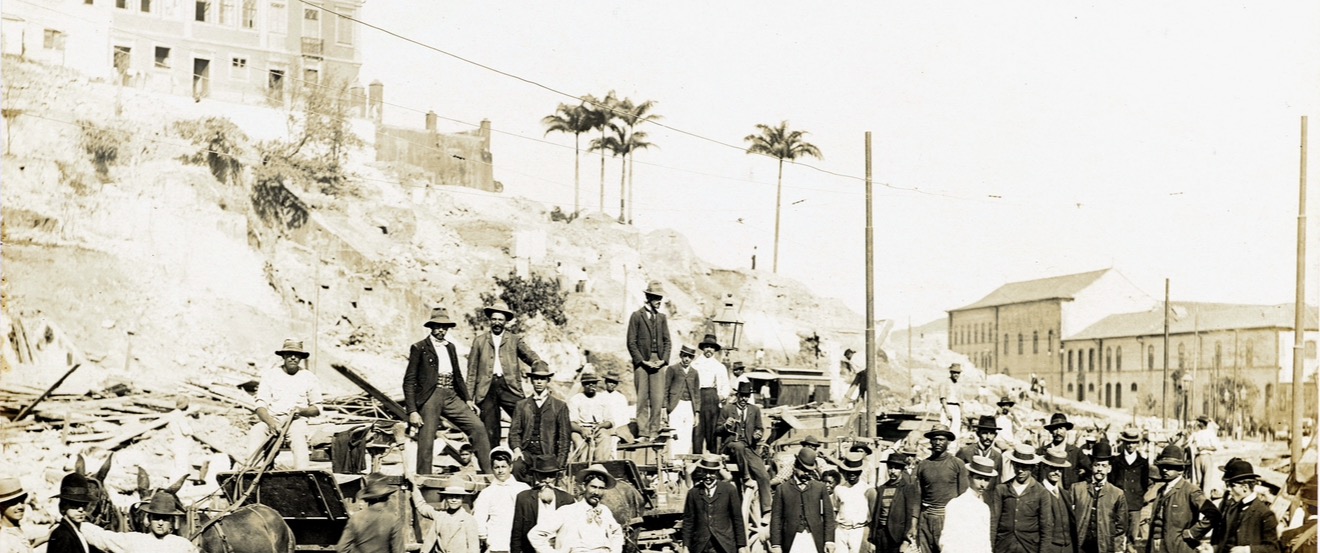
Pereira Passos’s Great Reform: A “Paris of the Tropics” and Its Human Cost
Gustavo Luís de Aguiar Vasconcellos
When people speak of historic tangible cultural heritage, especially in the European context, the images that often come to mind are city walls, castles, fortified towns, and magnificent churches of unsurpassed beauty. Many of them were built through the labor of enslaved people and serfs under Roman and feudal rule. Human blood flowed behind the beautiful postcard scenes we admire today.
In Rio de Janeiro, then Brazil’s Federal District, a similar context emerged at the beginning of the twentieth century. At that time, Mayor Francisco Pereira Passos was determined to eradicate from the territory under his authority diseases associated with Amazonian and medieval conditions, such as yellow fever, bubonic plague, and the ever-present smallpox. Because of these scourges, Rio de Janeiro was sadly known as the “City of Death.”
Having studied in Paris, Pereira Passos had been deeply impressed by the works carried out by Baron Haussmann, who, in the mid-nineteenth century, revolutionized the architecture and urban landscape of the French capital. A civil engineer by training, Pereira Passos was determined to transform Rio de Janeiro, especially its commercial and economic center, into a “Paris of the Tropics,” free from the diseases that had come to define its reputation.
Thus, in addition to supporting public health physician Oswaldo Cruz in the compulsory smallpox vaccination campaign, Pereira Passos ensured that the campaign focused on the tenements, old mansions, and colonial buildings where the disease spread most widely. These spaces were inhabited largely by formerly enslaved people and a predominantly working-class population. Such dwellings dominated the landscape of the city center.
Pereira Passos also launched a policy of large-scale demolition of those buildings, in what may have been the largest forced displacement in Brazil’s republican history. Around 1,600 structures were torn down to make way for an urban plan defined by broad, clean, and airy avenues, such as Avenida Central, now Avenida Rio Branco. At the heart of this transformation was the redevelopment of the Cinelândia area, where several buildings were erected, all in an Eclectic architectural style.
Among them was the Monroe Palace, a demountable structure that had won a pavilion competition in St. Louis, in the United States, and was reassembled in Rio de Janeiro in 1906. It later served as the headquarters of several political institutions until its criminal demolition by the military dictatorship in 1976. Also built during this period was the National Museum of Fine Arts, constructed between 1906 and 1908 and originally intended to house the National School of Fine Arts, heir to the Imperial Academy of Fine Arts. In 1937, under Getúlio Vargas, it became the museum itself, inspired by the Louvre.
The same period also saw the construction of the building that houses the National Library, built between 1905 and 1910 and now the largest library in Latin America, as well as the Theatro Municipal, built between 1905 and 1909. Modeled after the Paris Opera Garnier, it became the most luxurious opera house in all of the Americas.
Beyond these works, Rio de Janeiro has many others that, taken together, truly made it—and continue to make it—a “Paris of the Tropics,” with the affected areas cleansed of the diseases that had afflicted them. Around that time, Rio de Janeiro left behind the nickname “City of Death” and became known as the “Marvelous City.”
But the human cost was high. Former residents, forcibly evicted from their homes through the violence of the Federal District police, were not provided with an adequate public housing program—or, if one existed, it was wholly insufficient. Most were forced to seek shelter in relatives’ homes or to swell what was, until then, the small number of favelas beginning to spread across the surrounding hills. This process generated serious social problems that, unfortunately, persist to this day. Indeed, in many of these communities, there are still outbreaks of diseases that Pereira Passos and Oswaldo Cruz eradicated from the Parisianized center of their metropolis.
If monuments exist, they exist so that we may learn from them—not only chronology and architecture, but also humanism. Rio’s city center is beautiful, but behind that beauty lie stories of suffering that must not be forgotten, even as we admire it in all its splendor.
Gustavo Luís de Aguiar Vasconcellos