



Katherine Dunham and the Origins of Brazil’s First Law Against Racial Prejudice
Anapuena Havena
In 1950, Brazil cultivated the image of a country where racial prejudice was not openly visible.
Unlike other countries where racial segregation was practiced openly, such as the United States, Brazil saw itself as a society marked by harmonious coexistence among people of many different origins.
But one episode would shake that public image and force the country to confront a contradiction.
That year, Katherine Dunham, the American dancer, choreographer, and anthropologist, was in Brazil on tour with her dance company. Dunham had already worked with Brazilian themes before visiting the country. In 1939, she choreographed Bahiana, inspired by a woman from Bahia. In film, Carnival of Rhythm, released by Warner Bros. in 1941, also brought dance numbers based on Brazilian themes to the public.
In an interview published in the newspaper Correio da Manhã on March 5, 1950, Dunham, who was about to visit Brazil, said that “in the United States she had listened to many Brazilian records. But she had also read books by authors interested in questions related to Black influence. She immediately mentioned, with words of admiration, Gilberto Freyre and Arthur Ramos.”
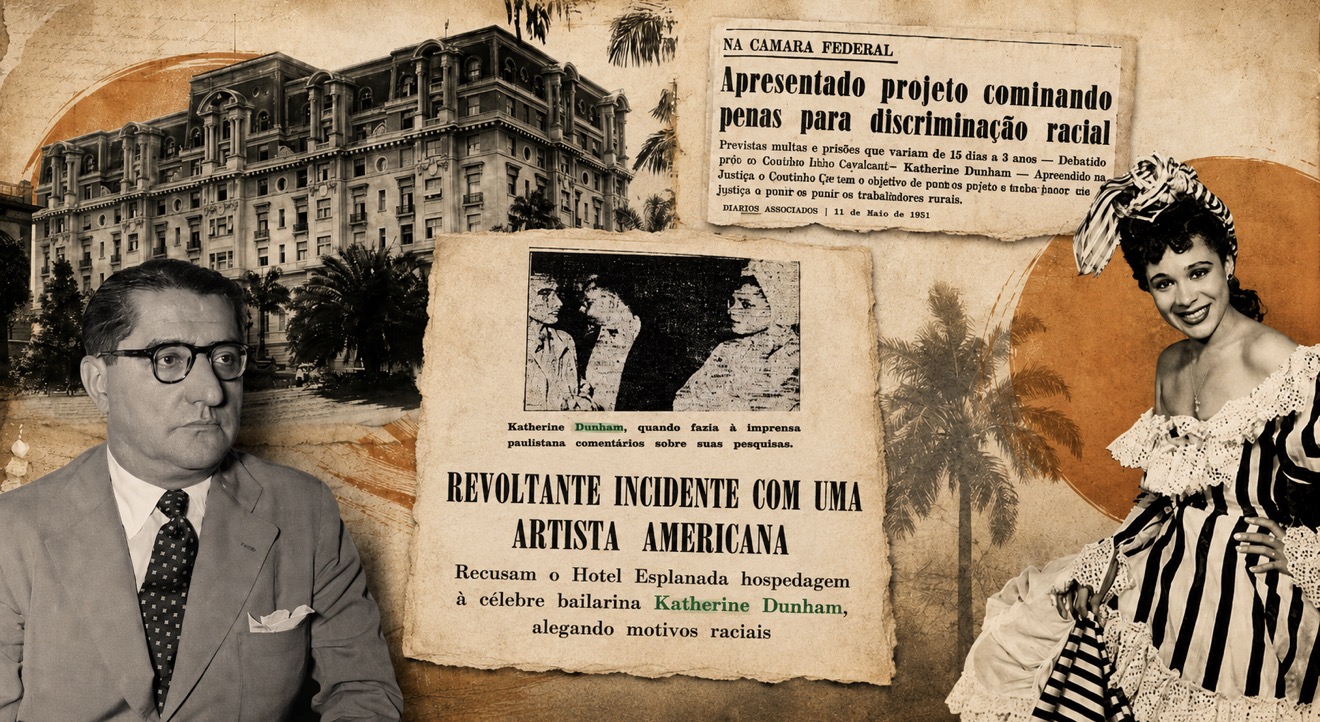
Her presence in Brazil was widely covered by the press, and her stay in Rio de Janeiro was very well received. Her next destination was São Paulo. It was there that an act of discrimination against the artist would leave a lasting mark on the country.
A reservation at the Hotel Esplanada had been made for Dunham and her husband two months in advance. The hotel was chosen because it was located next to the Municipal Theater of São Paulo, where her performances were scheduled to take place. A few days before her stay, however, Dunham was informed that the reservation would not be honored. The reason: she was a Black woman.
According to a report published in Correio Paulistano, Dunham herself publicly reported the incident on July 11, 1950, during the intermission of her performance at the Municipal Theater of São Paulo. Speaking to the press, she expressed surprise at being subjected to such humiliation in Brazil. She also said that, in Rio de Janeiro, she had stayed at the Copacabana Palace, where she had always been treated with the utmost courtesy.
The case had immediate repercussions. Correio Paulistano described the episode as a “revolting incident.” Brazil publicly upheld the idea that it had no racial prejudice, and what had happened at the Hotel Esplanada came as a shock to many.
The newspaper opened its article, published on July 13, 1950, as follows:
“It has always been said that color prejudice did not take root in our land. Indeed, this is a truth felt and recognized by all Brazilians, as well as by those who visit our country. It is very difficult to find any example of conduct by a Brazilian that could lead to a conclusion to the contrary. For this reason, whenever an episode such as the one that has now occurred at the Hotel Esplanada takes place, the outrage it provokes is mixed with genuine surprise.”
The press reacted quickly, and so did the political sphere. On the following Monday, July 17, 1950, Afonso Arinos de Melo Franco, a federal deputy from Minas Gerais, introduced a bill in the Chamber of Deputies that would make racist conduct a minor criminal offense. The case was also addressed by intellectuals such as Gilberto Freyre, then also a federal deputy, who spoke about the episode in the Chamber.
The bill provided penalties for refusals and restrictions motivated by prejudice based on race or color, including the denial of lodging, service, entry into establishments, school enrollment, access to public office, service in the Armed Forces, employment, or work opportunities. Approved by the National Congress, the bill was signed into law by President Getúlio Vargas on July 3, 1951, becoming Law No. 1,390, popularly known as the Afonso Arinos Law.
Although limited, the Afonso Arinos Law brought racial discrimination into the realm of legally punishable conduct in Brazil. It took a case involving a prominent foreign artist to draw attention to a problem that already existed in the country, even though it was often denied.
There is another case of racial discrimination that took place in New York involving a Black Brazilian man who was an important figure in the history of Imperial Brazil. But that story will be told in the next article.
Anapuena Havena